Tuesday, September 21, 2010

In the Moment


To wake up to.....
To wake up to


Who we are
What we are here for.


To make life
More poetical, more sane


more livin, lovin.
To experience the true of all things


In the moment....


In the moment.....

In the moment.....
by William Segal, painter and spiritual teacher


While drinking a cup of tea, will we be thinking of other things, barely aware of the cup in our hands? If so, we will be tucked away into the future--or the past-- and not living one minute of life.

Wednesday, September 8, 2010

Altered Imagery

I recently completed an online workshop on altered digital imagery. The workshop class I took was from Susan Tuttle. I learned how to use the tools, layers and filters in Photo Shop Elements.
The above image is one of my early (beginning) images. I know I have a long way to go now, and it will take much more experimenting, playing and trying all these new tools over and over again.
I highly recommend Susan's online workshops because I am a complete computer novice and I learned a great deal in her 4 week course.

Susan Tuttle offers a number of online workshops dealing with altered digital imagery. Her workshops include tutorial videos, print outs with step by step instructions, images to download for projects, and feedback to questions if needed. You can find more information about her upcoming workshops this fall here and she will be adding a brand new class to her list of workshops she offers.

You can find more of Susan's digital imagery at her website here and at her blog here.


Dorothy Simpson Krause is a painter, collage artist, book and print maker. She incorporates digital mixed media into her art. She is the author of many books, including the above book BOOK+ART: Handcrafting Artists' Books. She is also the co-author of DIGITAL ART STUDIO: Techniques for Combining Inkjet Printing with Traditional Art Materials. You can find more of her digital imagery (like the 2 below images) as well as links and information on how to purchase her books at her website here.


Smith Eliot had an unorthodox upbringing, raised by hippie parents in an old school bus, living a gypsy life as a young child. She received her MFA and currently teaches art at her local college. I first saw her digital imagery at a large art fair several years ago. Her imagery is haunting, mystical, and very memorable. You can find more of her beautiful imagery at her website here. Be sure to read some of her artist statements. Below is a sampling.


Those who will not slip beneath
the still surface on the well of grief
Turning down through its black water
to the place we cannot breath
Will never know the source from
which we drink--
The secret water cold and clear.
----- David Whyte

Wednesday, August 25, 2010

Visual Writing


collage, pressed flowers, book spine, book pages, old map, 10"x10"

I have been reading the book, WILD COMFORT: The Solace of Nature, by Kathleen Dean Moore. The book is filled with descriptive passages that are lyrical, poetic and beautiful- breathtaking. The words conjure up visual and sensual imagery in my mind. There is also a profound meditation on the healing power of nature, and how nature impacts writings such as poetry as well as visual artists, no matter what their medium is. Here is a sample:
"At first, the morning is flat as a sketch--sleeping bag laid out on a stone slab, narrow creek flowing from right to left, hillside filling most of the page. What texture there is seems to be drawn in lead pencil. Sound is flat and monochrome, too, the creek seeping steadily, rock to rock. People call it white noise, but today it is pale gray."

Lisa Sarsfield is a collage artist who often has bird nests as her theme.
You can find more of her work at her blog here.

Neva Gagliano is a poet and artist who has a wonderful blog here. Here is one of her poems:
If there's to be anything incessant,
let it be birds' calling
breezes on bare arms
chirping in the ears
and rain sparking
it all to life.

Novie Trump. Nest. You can find more of her ceramic sculptures here.

I was looking for images and writings on and by William Segal, painter and spiritual teacher.
This search led me to the blog of Luke Storms. You can find his thought provoking writings here. This is what I found:
Come to the edge.
We can't, we're afraid.
Come to the edge.
We can't, we'll fall.
Come to the edge.
And they came.
And he pushed them.
And they flew. --Guillaume Apollinaire


I live on a cliff overlooking the Puget Sound in the Pacific NW. This is a view of the beach below me.

Ben Judson, San Antonio Texas, is a freelance writer, web designer and artist. You can find more of his writings and poetry here. Here is one of his wonderful poems:
BACK TO ITS EXPOSED ROOTS
The arc of the visible river is long
but it bends toward moments
in which a song reaches out
with its silent hands
to grasp the darkness to lead it
back to its exposed root
its first whisper
its fading darkness.


Eva Francova. You can find more of her work here.
"We need stones around us to echo the substance of our own lives---hard, heavy, timeless, and subtly hued." Thomas Moore


acrylic, collage 8"x10"

Annie, from the United Kingdom, posts her beautiful prose and poetry at her blog Inkhaven which you can find here. Here is one of her poems:
BLACKBIRD
All these springs
we didn't know
what the tree-lined street
was missing.
Silver thread,
liquid song,
calligraphy on the run
outside the window.

Thursday, August 12, 2010

The Poetics of Subtle

There are artists who love color. By color I mean bright, strong, vibrant, luscious color.
They will put a color next to a color to create dynamic, active, energizing art works. I am not in that category. I am not into bright, vibrant, juicy colors. All I have to do is take a look in my closet, my home and my zen gardens to see that I like things around me that are more subdued and subtle and minimal in color. I prefer textures and nature-based objects. I love weathered, rusty, worn, wabi- sabi stuff. I have found other artists who are also into subdued, subtle colors.
Under all these quiet, subdued, subtle surfaces there is a pulsing beat of old blood, old memories, with waves of human feeling that are universal and call to me every time.

Thomas Meyers uses a combination of collage and drawing. He is exploring visual communication, from ancient writings to modern times. You can find more of his subtle, layered collages at his website here.
subtle: adj. a distinction so delicate or precise as to be difficult to analyze or describe. Subtle can create mystery.

Eric Adama works with mixed media on paper. He has a blog called CERULEAN which you can find here, where you will find more of his beautifully textured, subdued color paintings.
subdued: adj. (color) that is soft and restrained.
Subdued, subtle colors can be intimate.

Novie Trump works with ceramic sculpture and draws her inspiration from relics and ancient stories. Her work has a certain understated elegance as she uses subdued colors and subtle textures. You can find more of her beautiful work at her website here and her blog here.

Brent Harvey uses a variety of mixed media for his paintings. His limited palette gives his work a heightened perception of whatever he is trying to convey. You can find more of his fabulous paintings at his blog here and his website here.

Eva Francova works in a variety of mediums, from altered digital imagery to printmaking to ink drawings. But the overall connection in all her work is her subdued color, and limited palette.
Above is one of her digital images.

Above is one of Eva's ink drawings. You can find more of her delicate, poetic works at her blog I LOVE BLACK AND WHITE here, and also at her website here.


Roberta Marks works with collage, painting and assemblage. She explores the traces and vestiges of her journey from the past to the present. Her work appears simple with limited palettes, but they are actually delicately complex revealing subtle explorations of her/our world. Her website has more work here.

Come to my quietness
I shall cover you with it, like
a white sheet that has blown all day in
the sun, like a mountain lake
filled with spring, it shall slip over you.
--- Diane de Prima

Saturday, July 31, 2010

Outside In

I created this painting several years ago. An image of bird eggs is embedded in textured pastes.
Above the image is a rusty hinge and above that is a weathered piece of wood.

I love to bring nature's gifts inside my home. This is a new addition to my dining room table.
I have arranged rocks, driftwood, balls woven with tree bark, and small Japanese boxes that I have collected over the years.
Nature has innate beauty that makes an artist of the viewer.

These are sacred lingam rocks from a river in India. I have arranged them in a bowl on a table.
"One of the most important aspects of design is integration: not only the relationship of design to the process of manufacture, but to life itself and the creation of an environment." --- George Nakashima

The above is two collections of rocks. The first collection includes agates and crystals and quartz. The larger collection includes round beach rocks and grape vines.

The above fossils (ammonites and sand dollars) are arranged on top of a desk in my library. You can also see my favorite weathered balls and my love of rabbits.

The above are the former nests of gila woodpeckers in Arizona. They form their nests in the cavities of saguaro cacti. The sap from the cactus hardens the nest so these birds can use them more than once.

The saguaro boot nests have been added to my collection of bird nest, eggs, rocks, and drift wood in a container placed in my greenhouse.

A bird's nest and beach rocks and drift wood in a container

A fellow artist and master gardener, Betty Dorotik, has renamed my green house ZEN House which I like very much. The above arrangement is in a container in my zen house. To see pictures of my zen house (green house) go to my previous blog post here.
"The quality that we call beauty must always grow from the realities of life..."
--- Jun'Ichiro Tanizuki, In Praise of Shadows

Bonsai are Japanese dwarf trees. These miniature landscapes help convey simplicity, naturalism and harmony. These are a few of my bonsai that I have on my back decks and around my zen (green) house.


"One thing that was new to me in creating a Japanese-inspired garden was using many colors and textures of leaves, from light gray green to dark red, rather than using flowers for colors. The contrast adds depth and interest to the landscape, and the use of evergreens adds a timeless quality that is calming." Sakina von Briesen, Chado New Mexico

Friday, July 16, 2010

Japanese Elements of Design

new painting: acrylic and collage title: Rhythms

NAGARE: Flowing. Flowing water is a symbol of movements, dynamism and change. Its only constant quality is its mutability. The ebb and flow of water is a manifestation of the transforming power of nature.

Waterfall and pond near my deck of my home.

Wooden gate entrance to a shrine.

In Japanese gardens, sand is raked to look like water currents.

MARU: Circle. Extending a point into a line begins a journey that ends only when the line comes 'full circle' to return to its starting point. The circle thus symbolizes completion. A circle is harmonious and tranquil, yet it represents the cycle that is life. The circle is an opening, a window on the whole of being that it also represents, the eye that sees itself.

A banner outside a small restaurant, Kyoto.

A paper fan.

KATADORI: Sign. Calligraphy is a combination of kanji (a picture of a thing, or a diagram, or the essential form or spirit), and native syllables. There is a close link between reality and representation.

Shop curtain featuring kanji for 'day', Kyoto.

Store front in Kyoto.

SEI: Nature. Nature is the source of all art and design in Japan. The materials of art and architecture are rendered in forms that evoke their natural origins, and artifacts are decorated with images from the natural world.

Dragon flies and flower patterns on fabric.

Dragon pattern on door outside a temple, Kyoto.

KATA: Pattern. Repetition of line and form create serenity and harmony inside and outside the home.

Circle patterns on a door outside a temple, Kyoto.

Lattice window of a house.

Store fronts on small cobbled street, Kyoto

SEI: Sanctity. Rocks and trees, waterfalls and streams, animals and plants can possess sanctity. The sacred is announced with braided rope and twisted paper, with torii gateways and guardian statues.

Buddhist saints in a mountain cave at Rakanji Temple, Kyushu.

The Inari Fox at the entrance to the Fushimi Inari temple in Kyoto.

Fushimi Inari torii gates


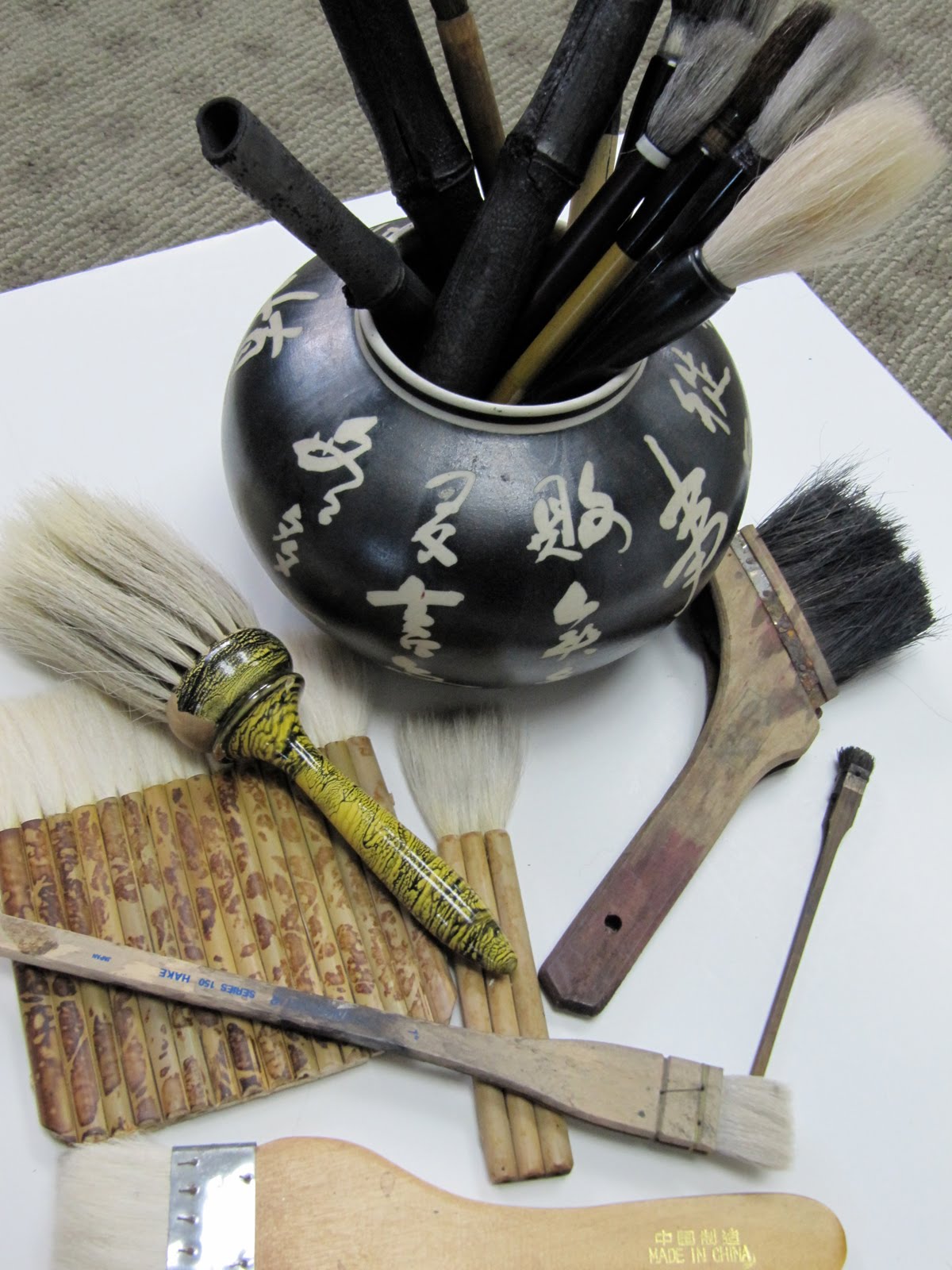
ATSUMARU: Collections. Collections can excite and charm, but they can also comfort and calm.


Some of my sumi and Japanese brushes.

Some game pieces and carved jade pieces.

A few Japanese dolls from my collection.


Some of the images in this post came from the above book: A Collection: JAPANESE DESIGN by Kenneth Straiton.