 new painting: acrylic and collage title: Rhythms
NAGARE: Flowing. Flowing water is a symbol of movements, dynamism and change. Its only constant quality is its mutability. The ebb and flow of water is a manifestation of the transforming power of nature.
 Waterfall and pond near my deck of my home.
 Wooden gate entrance to a shrine.
 In Japanese gardens, sand is raked to look like water currents.
MARU: Circle. Extending a point into a line begins a journey that ends only when the line comes 'full circle' to return to its starting point. The circle thus symbolizes completion. A circle is harmonious and tranquil, yet it represents the cycle that is life. The circle is an opening, a window on the whole of being that it also represents, the eye that sees itself.
 A banner outside a small restaurant, Kyoto.
 A paper fan.
KATADORI: Sign. Calligraphy is a combination of kanji (a picture of a thing, or a diagram, or the essential form or spirit), and native syllables. There is a close link between reality and representation.
 Shop curtain featuring kanji for 'day', Kyoto.
 Store front in Kyoto.
SEI: Nature. Nature is the source of all art and design in Japan. The materials of art and architecture are rendered in forms that evoke their natural origins, and artifacts are decorated with images from the natural world.
 Dragon flies and flower patterns on fabric.
 Dragon pattern on door outside a temple, Kyoto.
KATA: Pattern. Repetition of line and form create serenity and harmony inside and outside the home.
 Circle patterns on a door outside a temple, Kyoto.
 Lattice window of a house.
 Store fronts on small cobbled street, Kyoto
SEI: Sanctity. Rocks and trees, waterfalls and streams, animals and plants can possess sanctity. The sacred is announced with braided rope and twisted paper, with torii gateways and guardian statues.
 Buddhist saints in a mountain cave at Rakanji Temple, Kyushu.
 The Inari Fox at the entrance to the Fushimi Inari temple in Kyoto.
 Fushimi Inari torii gates
ATSUMARU: Collections. Collections can excite and charm, but they can also comfort and calm.
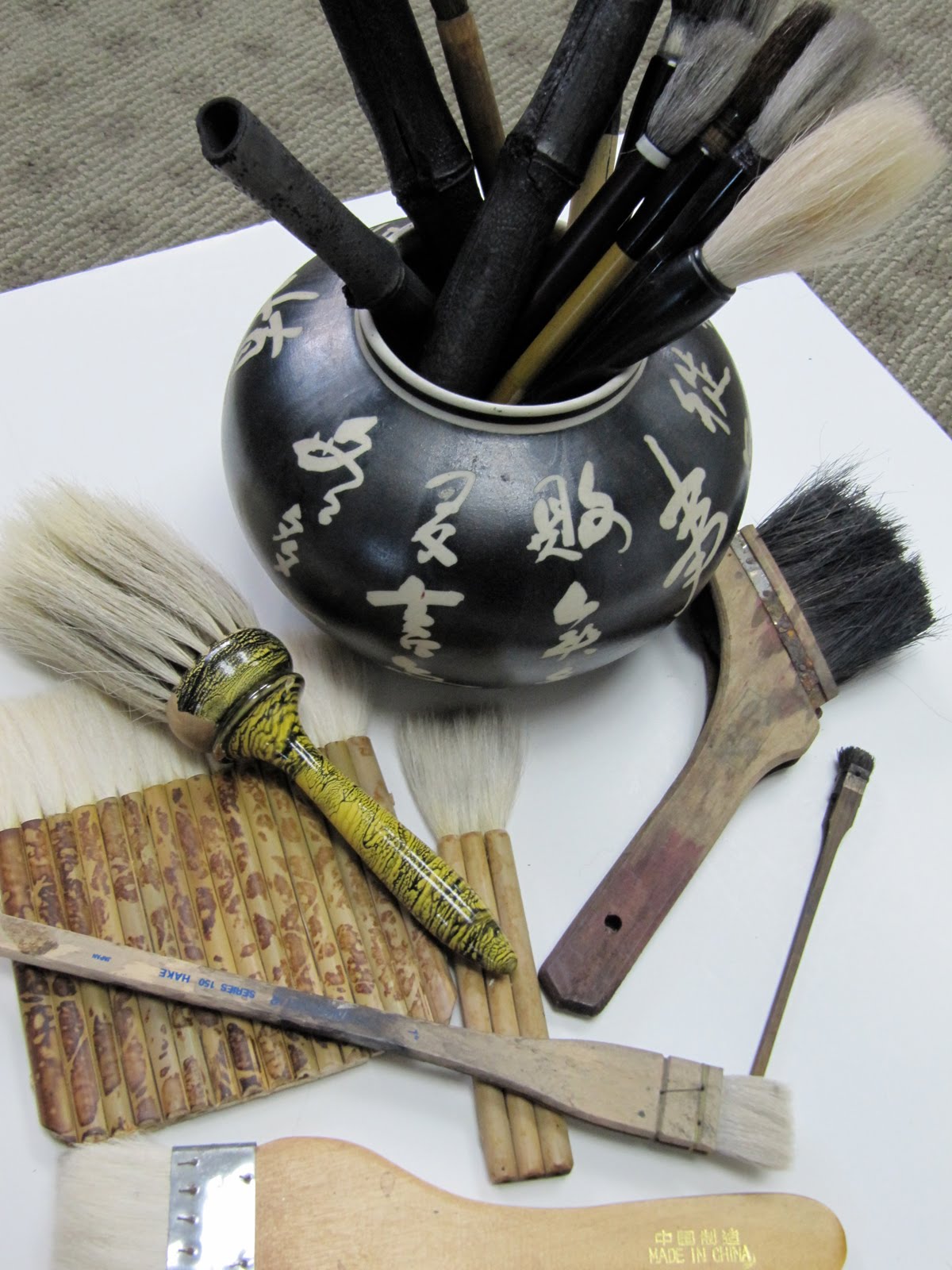 Some of my sumi and Japanese brushes.
 Some game pieces and carved jade pieces.
 A few Japanese dolls from my collection.
Some of the images in this post came from the above book: A Collection: JAPANESE DESIGN by Kenneth Straiton.


