Showing posts with label zen gardens. Show all posts

Wednesday, September 10, 2014

lingering summer light pt. 1

Reflections, cold wax and oil paints, Donna Watson

September... a pause for summer to say an awkward and lingering good-by and for autumn, sitting on a hill top, a jug of cider in one hand and a bunch of wild purple asters in the other, waiting to say hello.  (NYTimes)  As summer comes to an end, it is that time of year for me to post images of my Zen gardens and my Zen greenhouse.  I have decided to divide my images into 3 posts because I have so many to share.  This first post is all about my Zen house... what I call my outdoor decor.

Torii gate entrance to my Zen House

"...to walk without destination and to see only to see..." 
--- Uta Barth

Follow the stone path

"Your sacred space is where you find yourself again and again."
--- Joseph Campbell

Some of my bonsai in front of my Zen House

"The real voyage of discovery consists not in seeking new landscapes but in having new eyes"
--- Marcel Proust

One of the shelves inside my Zen House

"May my mind come alive today
to the invisible geography 
that invites me to new frontiers,
to break the dead shell of yesterdays, 
to risk being disturbed and changed."
---John O'Donohue, from a morning offer

A new birdcage, inside is a Japanese kokedama or moss ball with a Rabbit Fern

"Landscape consists in the multiple, overlapping intricacies and forms that exist in a given space at a moment in time."  Annie Dillard, Pilgrims at Tinker Creek

Kokedama or Japanese moss ball with Rabbit Fern

"Landscape is the texture of intricacy, and texture is my present subject... What do I make of all this texture?"  Annie Dillard

Another Kokedama, or moss ball with large wooden paddle

"The texture of the world, its filigree and scrollwork, means that there is the possibility for beauty here, a beauty as inexhaustible in its complexity, which opens to my knock, which answers in me a call I do not remember calling, and which trains me to the wild and extravagant nature of the spirit I seek."  Annie Dillard, Pilgrims at Tinker Creek
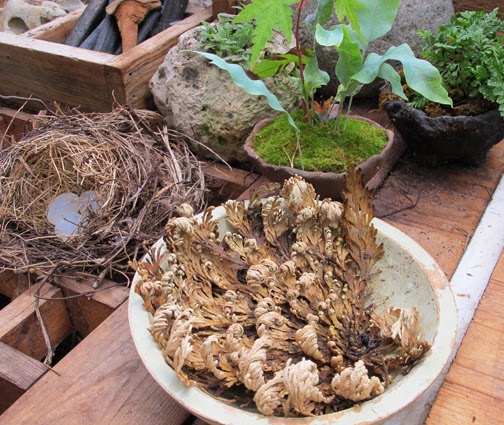
This is a Rose de Jericho, a type of desert moss,  which dries up into a tight ball without water.  When water is added, it will open up and burst into life, until the water dries up again.  

A water feature inside my Zen House

A corner of the Zen House

A round beach rock with a bee who passed away and has been sitting on this rock all summer

It doesn't have to be
the blue iris, it could be
weeds in a vacant lot, or a few
small stones; just 
pay attention, then patch
a few words together and don't try
to make them elaborate, this isn't 
a contest but the doorway
into thanks, and a silence in which 
another voice may speak.  
Mary Oliver


Saturday, October 15, 2011

Connecting the Dots in Kyoto

Boro, hand painted rice papers, acrylic, 2009

I am leaving for another visit to Kyoto very soon. My first visit was 2 years ago, in 2009. When I returned I began a new series of collages. The above collage was my first one completed after my visit. I know I have posted it before but I decided to include it here, because my first visit to Kyoto had a huge influence on my current body of work. I now approach my collage work like I work in my Zen gardens... like placing stones in the rock gardens.. with an eye towards balance and unity and rhythm and simplicity. Now I am going to Kyoto again.

I call my greenhouse my Zen house. It is part of me-- an extension of my art, my interests, my collections, my aesthetics.


In front of the Zen house is my collection of bonsai.

Inside the Zen House, is a corner with no plants, but some of my bird nests and rocks ...and containers that I love.


Have the courage to follow your heart and intuition. They somehow already know what you truly want to become. --- Steve Jobs

The above bird nests are new additions to my greenhouse this summer. The round rocks are from a beach near Port Angeles, Washington.

The above weather vane is a new addition. It is a metal rabbit that has moss for "feet".

There is a door. It opens. Then it is closed. But a slip of light stays, like a scrap of unreadable paper left on the floor, or the one red leaf the snow released in March. --Jane Hirshfield

I love to collect bird nests, and bird cages... but empty bird cages. And rocks....

"We work in the dark. We do what we can. We give what we have. Our doubt is our passion, and our passion is our doubt. All the rest is the madness of art. -- Henry James

I am going to Kyoto with an open mind. I have no idea what to look for, or what I am looking for but I know that important journeys begin that way.


And you wait, await the one thing
that will infinitely increase your life;
the gigantic, the stupendous,
the awakening of stones,
depths turned round toward you.
-- Rilke, The Book of Images

Monday, July 18, 2011

Zen Gardens, Zen Mind

Zen has one aim: to encourage us to take a closer look at all that is around us in the hope that once we develop a more intense insight, we will cherish and nurture this earth and its inhabitants. We learn to acquire a heightened awareness. Zen sharpens our senses, intensifies our perceptions and enriches our experiences. Every day events take on a new meaning. The ordinary is transformed into the extraordinary.
The following are some pictures of parts of my Zen gardens. Now you will see how I spend some my spring and summer days.


Tsukubai: Water basin -- for purification, so one can enter pure of mind and body
When we practice Zen we embark on a journey of self-discovery.

Stone lantern: for illumination

Be alive,
be here -- and know
the beat of your heart.


Small pond in front with goldfish.
All Zen asks is that we live our lives with compassion, creativity and a deep respect for all living things. There is a close connection with nature. Nature and human creativity are synonymous.
For Zen, art that depicts nature is considered an affirmation of life.


This bird bath is a new addition to my gardens.

This large rusty ball is a new addition to my garden

Zen is an experience for a way of life-- not a belief. Zen is passive-- it relies on us to teach ourselves.

The sound of silence: the stone garden
Zen wants us to pay full attention to the smallest details in life-- to be mindful of everything we do. Zen deals with the present. Life is too precious to waste.

Zen is about enjoying the simple things. At the heart of Zen there is the need for harmony and balance in life. To free the mind is to free the spirit... the resulting clarity of perception is just one of Zen's rewards.
Large pond in back with very large koi.

No thought
no form
only emptiness...
the joy of silence.

Water in the garden helps offset the weight of stone and provides melody, movement, and open, reflective zones.

Zen gardens are an attempt to control nature -- a balance between life forces in the natural world and the harmony and order in Zen. Gardens also want to provide a physical setting for quiet contemplation and mediation.


Stone, sand and rock
reveal the mysteries
of time.

The art of the inner work, which unlike the outer does not forsake the artist, which he does not "do and can only "be", springs from the depths of which the day knows nothing.
----- Eugene Herrigei, Zen in the Art of Archery


Sunday, February 13, 2011

Year of the Rabbit

This is the year of the rabbit. I love rabbits. I don't know why, really. Perhaps it is because they are so quiet and gentle. Above are 2 handmade scrolls.


I have stone and metal rabbits throughout my home.


I have stone and metal rabbits in my Zen gardens.

This is the Chinese Year - of - the - Rabbit horoscope. If you were born in 1939, 1951, 1963, 1975, 1987 you would be a 'rabbit'. When Buddha lay dying, he summoned the animals to bid them farewell. The cow was the first to hasten to the scene but the rat, riding on the cow's back, jumped off and arrived first. Thus the rat became the first animal in the Asian zodiac, a cycle of twelve years that assigns a different animal to each year. A person is thought to take on characteristics of the animal representing the year in which she or he was born. Since nature is the source of all art and design in Japan, you can find animals depicted in many of their art forms.


Wood carving.
Those that are born in the year of the rabbit are considered articulate, talented and ambitious. They are often lucky.


Macau postage stamp 1999


Netsuke are miniature sculptures invented in 17th century Japan. They were first used as 'toggles' to help close bags that Japanese men wore to carry around their belongings.
Eventually, netsuke became a highly honored art form.


A ceramic cup


Rabbit's frozen pose--
breaking loose he springs away,
melting through the fence.


You can find more of Kris Hargis' drawings at this gallery in Portland, OR here.


Geoffrey Gorman creates his animal sculptures from all sorts of materials.
Find more of his wonderful sculptures at his website here.


"I don't see much sense in that," said Rabbit. "No," said Pooh humbly, "there isn't. But there was going to be when I began it. It's just that something happened to it along the way." --- Winnie the Pooh